
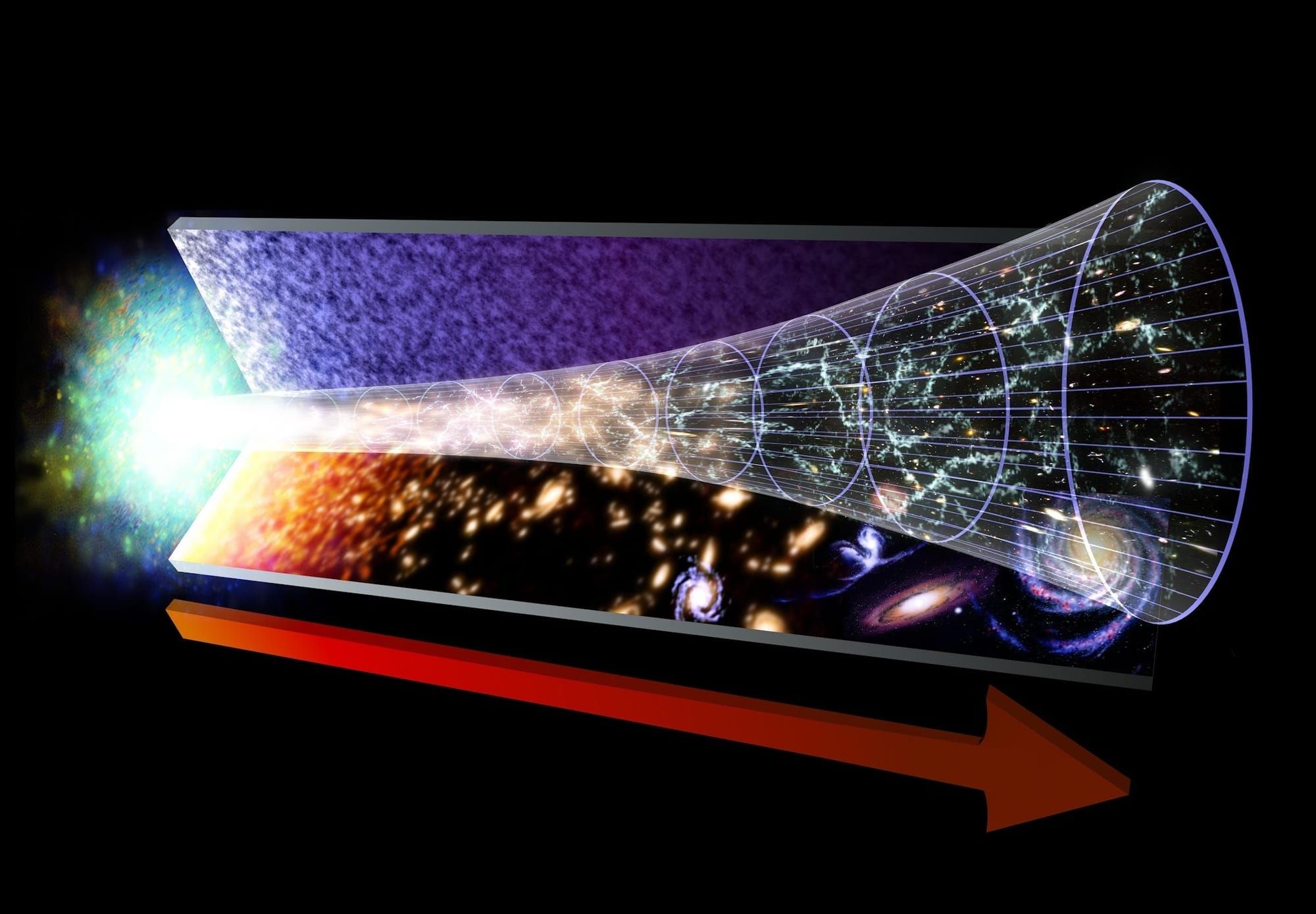
Scientists have discovered that an exotic particle that existed at the birth of the universe might solve one of the biggest mysteries in cosmology and help explain reality as we know it, according to a new study in Physical Review Letters.
Our modern universe is dominated by matter, but it also contains fleeting amounts of antimatter, which is like a bizarro version of matter made of particles with the same mass, but opposite electrical charges. For instance, matter contains positively-charged protons and negatively-charged electrons, whereas antimatter is made up of the inverse: negatively-charged antiprotons and positively-charged positrons.
As a result of these opposite features, matter and antimatter particles annihilate each other when they meet. This mutual destruction is the source of a major cosmic mystery, given that equal amounts of matter and antimatter are predicted to have formed in the split-seconds following the Big Bang. Yet somehow, matter emerged as the far more dominant substance in the cosmos, an asymmetry that has yet to be explained.
Now, a pair of scientists have pinpointed an overlooked particle, known as the heaviest decoupled right-handed neutrino (RHN), as a solution to this problem—plus, they predict that their hypothesis could be experimentally tested in the future.
“No one talks about this decoupled right-handed neutrino,” Rishav Roshan, a research fellow at the University of Southampton and a co-author of the study, told 404 Media. “We realized that this decoupled right-handed neutrino could alter the expansion of the universe and affect the matter-antimatter asymmetry of the universe.”
“This thing was present in the literature for a very long time, and for some reason people did not pay that much attention to this particular point,” he added.
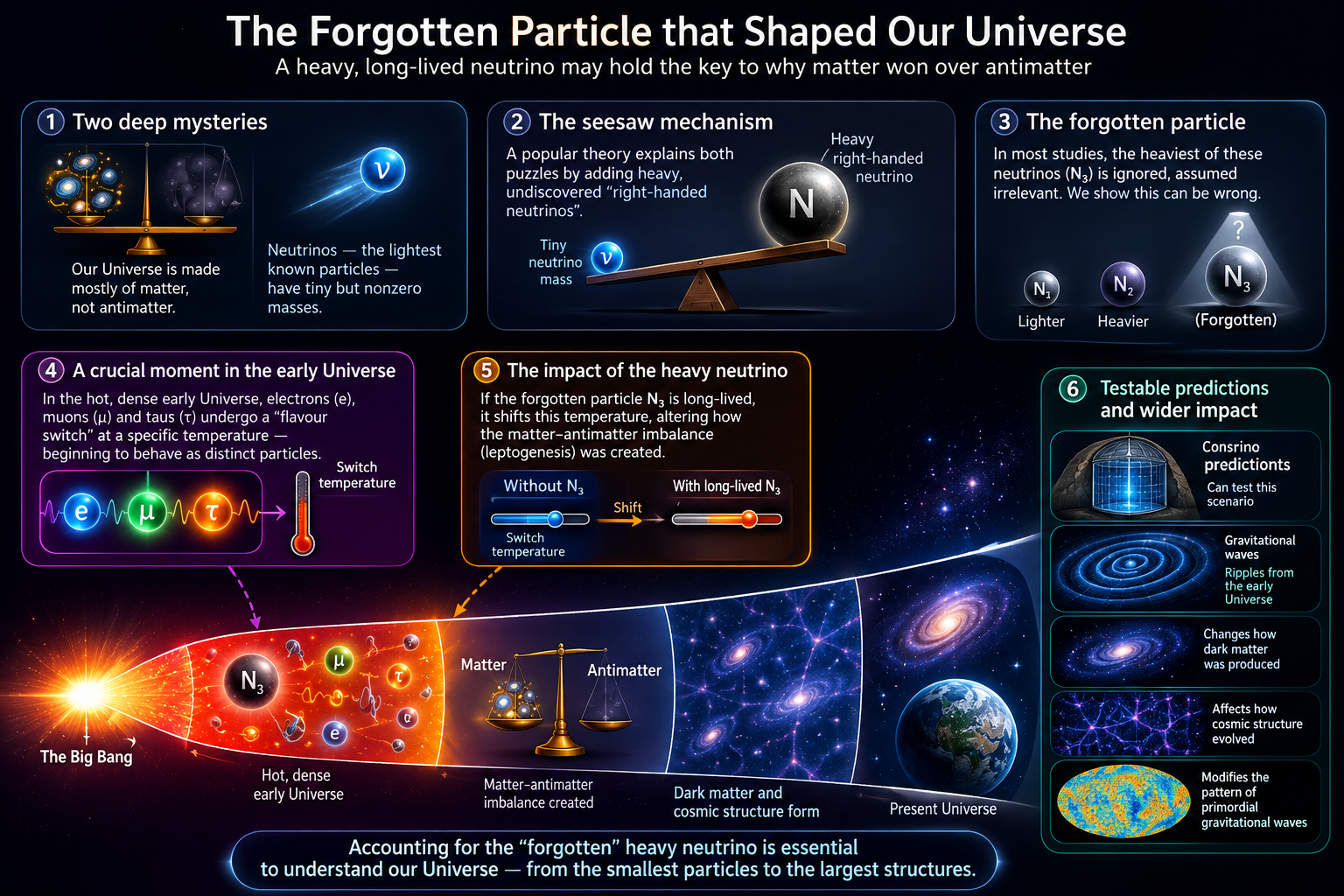
This particle is the heaviest of a trio of hypothetical decoupled RHNs that existed briefly after the Big Bang, and are key to the “minimal seesaw model” that explains the origin of modern neutrinos, which are extremely lightweight particles that are abundant in the universe today.
“The heaviest decoupled right-handed neutrino is a particle that exists in the minimal seesaw model but interacts very weakly with regular matter, making it nearly invisible to current experiments,” Roshan told 404 Media. For this reason, he noted that this particle has been “overlooked because many researchers focus on the lighter neutrinos” and view “the heavy states as irrelevant due to their minimal influence on observable physics.”
Roshan and co-author Sudipta Show, a postdoctoral researcher at the Indian Institute of Technology Kanpur, had a hunch that this exotic heavy particle could have played a role in the domination of matter in the early universe. In their new study, they included the particles in models of the primordial universe, which suggested that the particle could have slowly decayed, creating an imbalance in particles known as “leptons”—a class that includes different “flavors” such as electrons, muons, and neutrinos—that was then amplified into the larger matter-antimatter imbalance.
“In the early universe, when this heavy neutrino was produced, the temperature of the universe was extremely high, much greater than the mass energy of this neutrino, and it behaved as radiation,” Roshan explained over email. “As the universe began to expand, its temperature slowly decreased.”
“Once the temperature fell below the mass energy of the heavy neutrino, the particle became non-relativistic and started to behave like matter due to its extremely weak interactions, influencing the dynamics of the universe's expansion and affecting the creation of matter versus antimatter,” he continued.
Scientists have already pinpointed the process of uneven lepton and antilepton formation—known as leptogenesis—as a leading explanation for how matter dominated the universe. Roshan and Show now demonstrate that the heaviest decoupled RHN is key to this hypothesis and should be included in future models.
Moreover, the team noted that a new generation of observatories could potentially detect this process hidden in gravitational waves, which are ripples in spacetime. Current detectors, such as the Laser Interferometer Gravitational-Wave Observatory (LIGO) can pick up gravitational waves made by cataclysmic events, such as mergers between black holes. But a spate of advanced detectors, due to come online in the 2030s and 2040s, are designed to tune into “primordial” waves from the split-seconds after the Big Bang, which may contain spectral signs of the heaviest decoupled RHN.
“Future detectors like SKA, LISA, DECIGO, and ET could potentially observe these signatures. These instruments are being developed to detect gravitational waves, with some expected to come online within the next few years. If successful, they could pick up signals related to the heavy neutrino’s effects on the early universe,” Roshan wrote over email.
“Solving the matter-antimatter asymmetry question could transform our understanding of cosmic evolution and the fundamental laws of physics,” he added. “It may challenge or refine the Standard Model and influence theories of the universe's formation and structure. A new understanding of this asymmetry could also lead to insights about dark matter and the early moments of the universe, potentially reshaping our view of cosmic history.”