
The Texas sheriff’s office that used Flock to search more than 80,000 cameras nationwide for a woman who had a self-administered abortion used Axon’s Draft One AI tool to help write a police report about the incident, documents shared with 404 Media show. The tool was used in part to summarize a discussion of “the legal implications of the situation.”
404 Media first reported on the incident in May 2025 in which the Johnson County Sheriff’s Office in Texas searched Flock’s nationwide network for the whereabouts of a woman who self-administered an abortion, highlighting the threat of this AI-powered surveillance system being used to criminalize or track women seeking reproductive healthcare. The use of both Flock and Axon’s Draft One, which uses audio from body camera footage to automatically draft police reports using artificial intelligence, shows how quickly police departments have come to use AI surveillance tools even in critically sensitive cases.
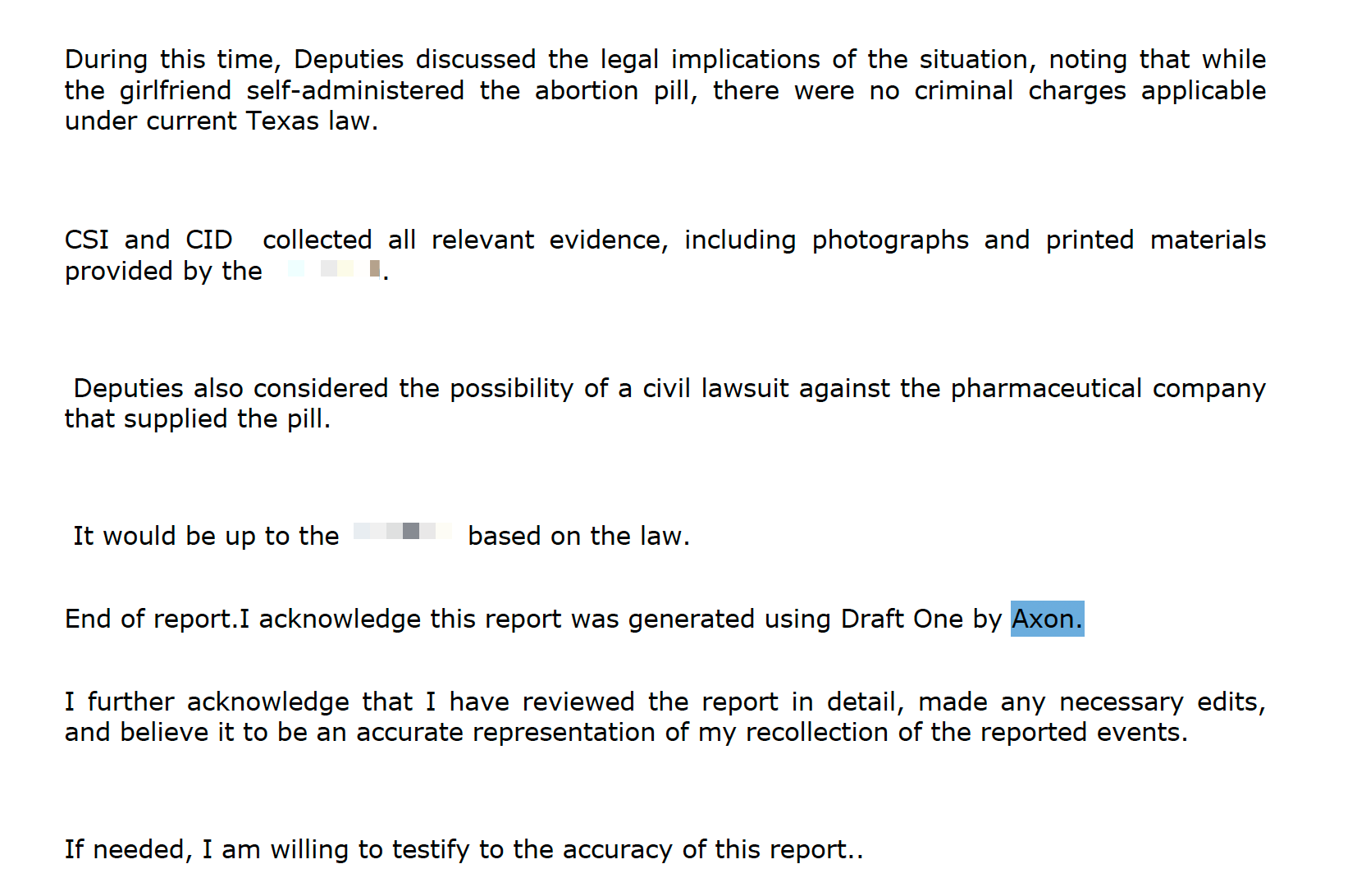
“I acknowledge this report was generated using Draft One by Axon,” a section of the report reads.
The abortion case has since become a flashpoint in the controversy over the use of Flock automated license plate reader (ALPR) cameras. Flock’s CEO, Garrett Langley, has repeatedly and erroneously suggested that 404 Media misreported the case and that the search was done only for the woman’s safety because her family was worried about her. 404 Media previously reported that the entire police investigation was done at the behest of the woman’s abusive partner and that police discussed whether they were allowed to charge her with a crime: “It was discussed at the time with the District Attorney’s office and learned the State could not statutorily charge [the woman] for taking the pill to cause the abortion,” a police report previously obtained by the Electronic Frontier Foundation and shared with 404 Media said. Concern from her family is never mentioned in that earlier police report or in the AI-generated police report used to write this article.
The AI-generated incident report was obtained by journalist Cameron Probert of the Tri-City Herald and shared with 404 Media. The report shows there is extensive body camera and audio evidence that would clarify what happened in the case, and that at least one police officer, sergeant Damien Bethel, used Draft One to write his report on the incident. Parts of a police incident report show that Draft One was used to summarize a discussion between police over “the legal implications of the situation” and other investigative aspects of the case. The Johnson County Sheriff’s Department has repeatedly refused to release body camera footage from the case, including in response to 404 Media’s public records requests.
“Deputies discussed the legal implications of the situation, noting that while the girlfriend self-administered the abortion pill, there were no criminal charges applicable under current Texas law,” Bethel’s report states, providing no more details about the specifics of the discussion. “Deputies also considered the possibility of a civil lawsuit against the pharmaceutical company that supplied the pill.”
Bethell’s Draft One report further states, “There is digital multi-media evidence from Body Worn Camera footage of this call for service in the AXON Evidence Library. There is digital multi-media evidence of In-Car Camera footage of this call for service in the AXON Evidence Library or the WatchGuard Evidence Library. There were digital images captured while on the scene.” The Johnson County Sheriff’s Department has thus far refused to release even redacted versions of this evidence that the EFF and 404 Media have separately requested.
Leaked audio of Langley obtained by 404 Media, recorded by Signal Akron, shows that as recently as earlier this month, Langley was still lying about the specifics of the case to law enforcement customers of Flock. “She was in an abusive relationship and the family was concerned that she was in danger. They were trying to find her because they were worried her life was at risk,” he said. There is no mention of the woman’s family being concerned about her in any of the police reports; the only person who expresses concern about her in the police narratives is her abusive partner, who told police that the abortion happened weeks prior to their investigation. So-called “welfare checks” have repeatedly been used by abusers to harass women who have gotten abortions and, in Wisconsin, a police officer allegedly illegally used Flock to see if his ex-girlfriend had gone to an abortion clinic.
Another section of the report detailing the Flock searches shows that the officer who did the Flock searches never went to the woman’s house, and looked her up in a credit card header database system called TLO to find her addresses and vehicle information. His section of the report describes his searches as being for her safety because he worried that the man who reported her (her abusive partner) could have hurt her. He does not mention doing the search at the behest of her family.
“I began to believe the victim may have been hurt by the RP [reporting person] due to the call and it not making sense. I wanted to use resources available to help find where the victim and her children could be to make sure they were okay,” the officer wrote. “I entered the vehicle into FLOCK to see if we could see where the victim and her children might be at due to multiple different locations being given for the victim and her children. Deputies had attempted to try and contact the female, but were unsuccessful. The FLOCK hit showed the victim had been in Dallas prior but nothing recent. The reason for the FLOCK search was to find out what city the victim and her children might be in and give us an idea of where to look for them, due to the large area of where the victim and her children cold [sic] be at.”
When contacted for comment, the Johnson County Sheriff’s Office would not provide more details about the case or the use of Draft One to write portions of the police report to 404 Media. Keven George of the sheriff’s office said, “Draft One works by uploading and transcribing body‑camera audio once an incident concludes. Within about five minutes, a preliminary narrative based on that transcript is generated. Officers remain fully in control of the final report: they review and edit the draft, fill in missing details, and approve it before submission. Safeguards, such as placeholder ‘insert’ prompts, help ensure accuracy and prevent the system from guessing details it cannot verify.” He added, “the Deputy has to digitally sign before the narrative can be used.”
Paris Lewbel, public relations manager at Flock, told 404 Media “As Garrett said, the case report from Johnson County details that authorities explicitly stated she could NOT be charged with a crime.”
Forbes recently reported Axon’s AI tools sometimes introduce errors that officers then need to spend time removing.